




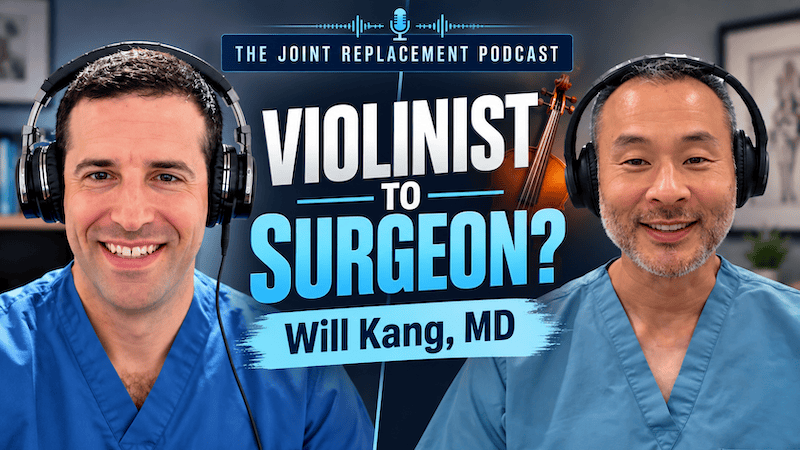
#56 – What Does a Professional Violinist Know About Orthopedic Surgery? Will Kang, MD
https://youtu.be/HjjOuhPsPBA What does a professional violinist know about orthopedic surgery? In the case of Dr. Will Kang, quite a lot. Before becoming a board-certified orthopedic surgeon, Dr. Kang trained seriously as a classical violinist, earned a master’s degree in violin performance from the Cleveland Institute of Music, and worked as …
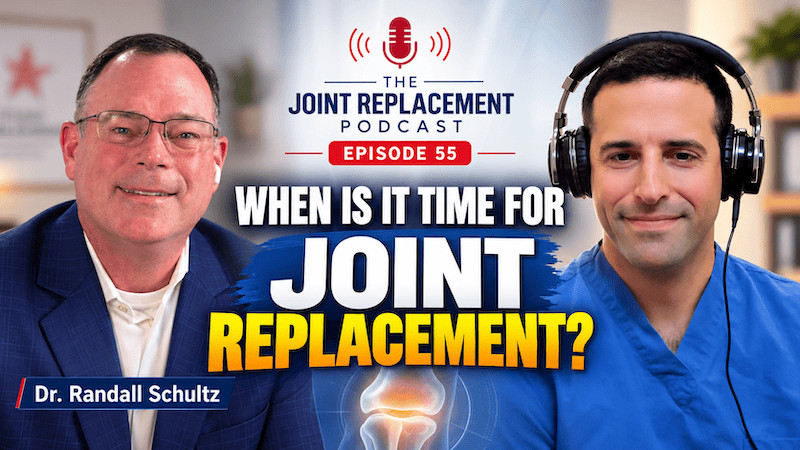
#55 – How Do You Know When It’s Really Time for Joint Replacement? Randall Schultz, MD
For many patients with hip or knee arthritis, the hardest question is not whether joint replacement works. It is deciding when the time is right to actually have surgery. In Episode 55 of The Joint Replacement Podcast, I sat down with Dr. Randall Schultz, a board-certified orthopedic surgeon at Texas …

#54 – Can You Prevent Arthritis & Joint Replacement? Jocelyn Wittstein, MD
What happens to a joint decades before someone ever needs a hip or knee replacement? That was the central question in Episode 54 of The Joint Replacement Podcast, where I sat down with Jocelyn Wittstein, MD, an orthopedic sports medicine surgeon at Duke whose work spans ACL injuries, post-traumatic arthritis, …

#44 – Can Ultrasound Treat Arthritis Without Injections? George Lewis, PhD
Knee osteoarthritis is one of the most common problems I treat, and patients are increasingly interested in options that fall somewhere between medications and joint replacement. Cortisone injections, hyaluronic acid, physical therapy, anti-inflammatory medications, PRP, laser therapy, red light therapy, TENS, and shockwave treatment are all frequently discussed. But another …
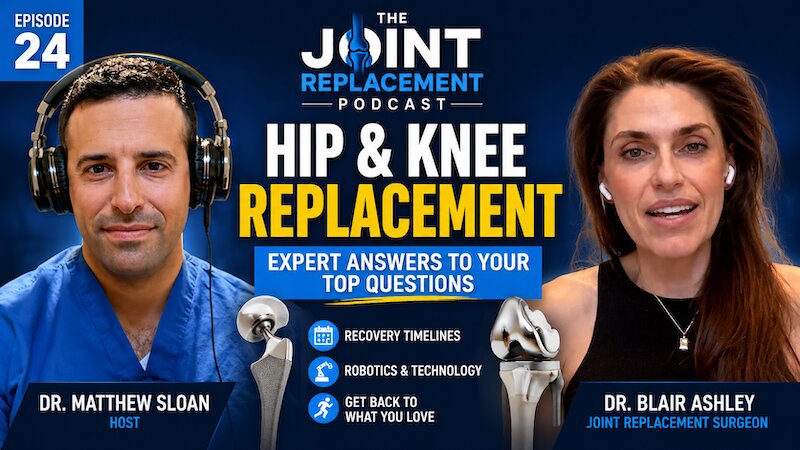
#24 – What Questions Should Joint Replacement Patients Ask? Blair Ashley, MD
The Joint Replacement Podcast with Matthew Sloan, MD Choosing whether to undergo a hip or knee replacement is one of the most important healthcare decisions many patients will ever make. Yet despite the success of modern joint replacement surgery, patients are often faced with conflicting information about recovery, implant longevity, …
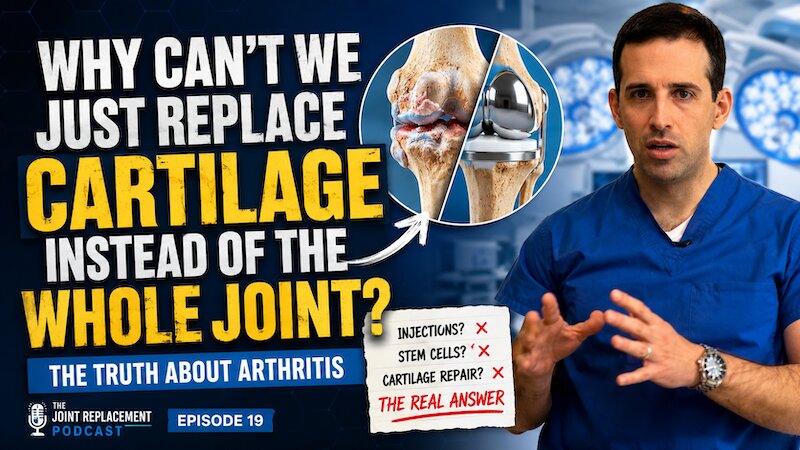
#19 – Why Can’t We Just Replace Cartilage?
Most patients who are told they need a hip or knee replacement ask some version of the same question: “If arthritis means the cartilage is worn out, why can’t you just replace the cartilage?” It’s a logical question. If the problem is damaged cartilage, shouldn’t the solution be new cartilage? …

Same Day Surgery for Partial Knee Replacement — Presentation at American Association of Hip and Knee Surgeons 2021, Dallas TX
Finally got the full video from our #AAHKS2021 presentation. Always honored to be a part of the discussion to improve care for our joint replacement patients.

Activity Modification for Arthritis
The least invasive, easiest way to decrease symptoms from arthritis is to avoid activities that cause pain. This is what we call “activity modification”.

5 Questions Your Surgeon Will Ask You
When you go to see your joint replacement surgeon about hip or knee pain, be ready for them to ask you the following five questions. Each question is asked to determine specific bits of information to help us piece together the source of your pain and the best treatment options, even before we do a physical exam or look at your x-ray imaging.

Arthritis X-Ray Classification Video
In 1957 Kellegren and Lawrence release their landmark paper on a new x-ray classification system for arthritis. This system would become the gold standard after the World Health Organization adopted it as their arthritis classification in the 1960’s. At the time of the release of the K-L system, it was typical that only one x-ray was available to diagnose a patient, because the radiation doses were so high, it was risky to obtain multiple shots.